
Satur Prieto Esteban (90 years old)
Villaverde de Guareña, Salamanca, Spain, 21 April 2026
María Saturnina Prieto Esteban was born on 9 September 1935. She comes from a family dedicated to the primary sector and is currently a widow, with three children and two grandchildren.
She lives in Villaverde de Guareña, a small municipality located in the north-east of the province of Salamanca, Spain. It currently has 128 registered inhabitants. It is a rural setting where much of the population has traditionally lived from agriculture and livestock farming.
This interview was conceived as a way of establishing a contrast between different generations of women and their ways of life, bringing past and present into dialogue. Through this exchange, the aim is to allow younger generations to learn what life was like in the past, while also recognising the value of the knowledge, practices and traditions that, in many cases, risk disappearing if they are not passed on and acknowledged.
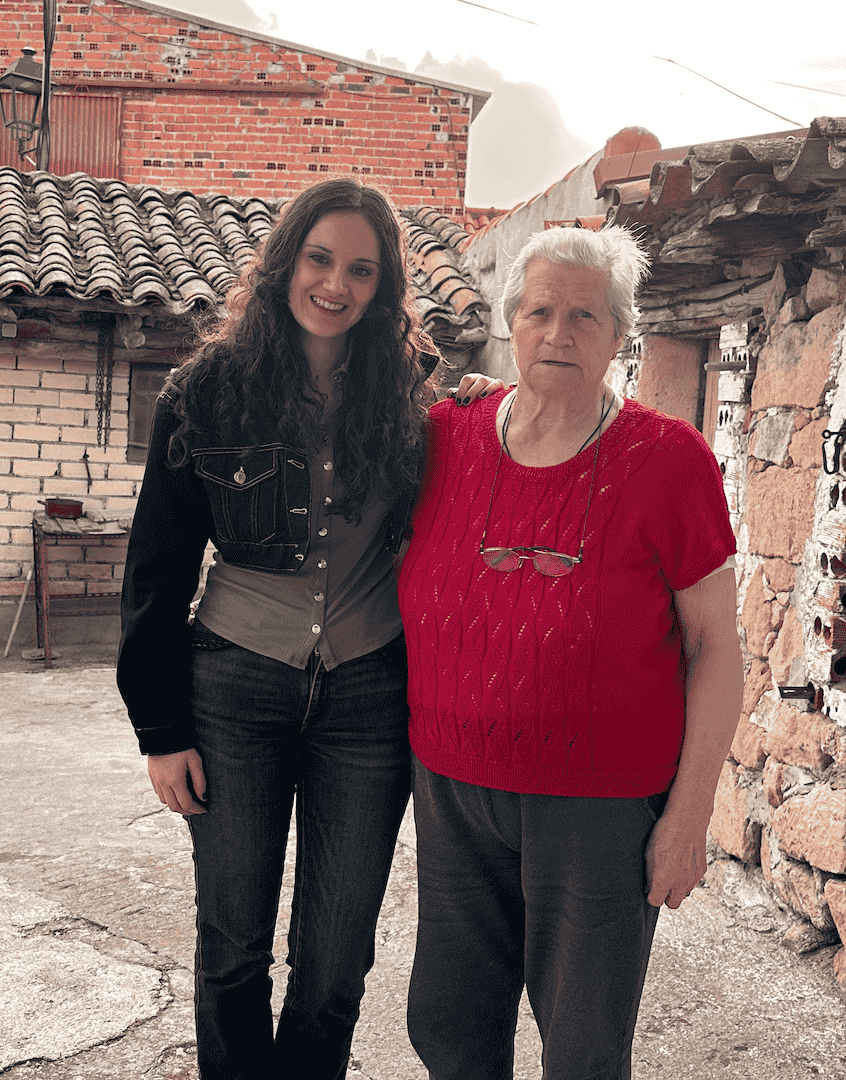
R: Satur, you live here in Villaverde, and you were also born here. Have you always lived in this village?
S: Always, in this same house. I have lived here all my life. I was born here, and I am still here, and here... I won’t die. Unless God grants me a sudden death, then perhaps I will (laughs).
R: The house must have changed a lot over the years.
S: Yes, a lot. This room we are in now used to be the hen house; that dining room over there was a feeding area for the animals. When we slaughtered a cow, my father always brought it from Ciudad Rodrigo (another town in Salamanca located about 105 kilometres from Villaverde) we kept it there in the feeding area and when the it got cold in winter, the oxen were kept in the shed, but if it snowed or the wind blew straight at them, we brought them in here.
The truth is that these houses, village houses, were built more for the livestock than for the family. You would go out into the yard and it was much bigger; inside, the whole family simply fitted in as best they could. In general, there were only the two or three bedrooms the house had, depending on the number of children, of course. We had three.
What is now the bathroom used to be the donkey shed and the stable. We came in through that corridor. All of that used to be animal sheds, but that was what people made a living out of.
R: How many people lived here when you were a child?
S: I lived here with my parents and my brothers: Leo, Agustín and Nicolás. I had another sister, but she died when she was 19.
R: What did your father and mother do for a living?
S: My father worked in the fields, and my mother took care of the house and did sewing. She and I would sit by the fire at night and prepare whatever needed basting, so that the next morning we could sew it on the machine, and then finish it off however we could.
Back then, we made underpants, shirts, nightgowns, knickers, socks, we made everything ourselves. Later on, I learned to embroider. We always tried not to leave too much to sew on the machine, but of course, there were many of us too. Back then, everything was sewn and mended; nothing was thrown away. Now everything is thrown away.
R: So your brothers worked with your father, helping to look after the animals, while you helped your mother.
S: Of course, they went with my father more than I did. I stayed with my mother, sewing. Back then, people sewed a lot, not just us, everyone did. Families with many children made everything themselves. And clothes were passed down from one child to another.
Then, when we had to wash everything, we went to the spring to do the laundry; other times, we went to the lagoon. At home we also had a washbasin for smaller things. Angélica and I went six times all the way to the river, over in Aldealengua (another town in Salamanca). We went there on the pack animals, carrying the washing boards and the saddlebags. We had white saddlebags for the clothes.
We set off before dawn; you couldn’t see anything when we left in the morning. I remember one time, Angélica and I were going alone, and as we were going down the slopes, a man, who must have got up even earlier than us, was probably on his way to sell cabbages and other things, and one cabbage fell to the ground. Angélica got down to pick it up (laughs). I didn’t want to get down; my father had a vegetable garden.
R: It must be about 15 kilometres from Villaverde to Aldealengua. Why did you go so far?
S: Because here, at the lagoon, there sometimes wasn’t enough suitable water for washing.
R: Did you go to Salamanca, to the city?
S: Not to do the washing, no, but we did go several times for other things, especially to buy things. Later, when my brother got married and stayed there to live, we would go to visit him.
R: Apart from all these tasks, washing, sewing and helping your mother, did you also go to school?
S: Yes, here in the village. I went with my brother Leo. Not with the older ones, because there was more than four years between us. They put us together in the same classes, older and younger children all together, although later they separated the boys and the girls.
R: Why were you separated? Were you and your brother taught different things?
S: Well, I don’t know. I think it was more or less the same. I remember I didn’t like maths very much, but I did like reading and learning words.If I had had the opportunity to study, I would have chosen the humanities branch or perhaps something else, I’m not sure, because I have always really enjoyed reading.
R: And at what age did you leave school?
S: At 14. After that, nothing. My brother Leo did continue studying afterwards in Salamanca. And even before then, I couldn’t really go to school very much either, because I remember that when my sister died, I must have been about 10 or 11, we had to go to church every day and mourn for her.
R: What happened to your sister?
S: They said at the time that it might have been tuberculosis. We had to go to church every day and light the candles there. And if my mother didn’t go, then I had to go to instead of going to school. Then, after , if it was still early, I would go to school. I don’t really remember much more about that.
R: And once you left school at the age of 14, did you stay at home?
S: At home until I got married. And then I got married, and I was still at home all the same.I got married in a church in Salamanca. I was 28 years old. A lot of people got married here in Villaverde at that time too, but my mother had died a year earlier and I was in mourning… I got married in black. Nowadays, no one wears mourning clothes anymore.
R: You have spent your whole life in Villaverde. It must seem to you that it has changed a great deal over all these years.
S: Yes, there used to be more festivities than there are now (laughs). There was San Antón, the festival of the quintos, when they held the rooster race and then had a dinner. When my brother Nicolás was one of the quintos, we had the dinner here. People were coming in and out, there was dancing and everything. It was lovely.
Then we also had Santa Teresa. On Santa Teresa’s Day, we went with a religious brotherhood. I still have the medal somewhere, with a blue ribbon, which we used to wear here. We were also mayordomas. There was more atmosphere, more festivities, more dances. People came from other places, lots of young men from all the nearby villages.
I also remember when we used to go to the square to fetch water, because of course there was no running water. I used to go up there to a water spout, but there were several: there was that one, the one in the square, another one near Fani’s house… You would meet there with the water jugs to collect water, and you would have a chat with people. You would also meet people when you went shopping. There were two grocery shops here.
R: What could you buy in the grocery shops?
S: Well, things like noodles, rice, olives, cheese… lots of things. We always went to Mrs Francisca’s shop, which was here in the square, and then there was another one further along.
R: When you got married, did you and your husband also live from the land?
S: Yes, he worked in the fields, just like my father, and I looked after the house. But later, when we had the dairy cows, we never had more than four, because no more than four would fit in the stable, I always milked them.
Look, in the summer, when my husband Modesto went off to harvest, everything was left in my hands. The cows, we would take them out there to the vegetable garden. We had a fenced-off area, and in the summer they would stay there, even to sleep. Later on, not anymore.
R: You women were also the ones who helped the priest and kept the church clean.
S: Of course, yes, yes, we used to go and clean. During the years when Modesto was mayor, I always went to sweep the church and do all of that.
I also sewed for the priest. Once I altered an altar cloth for him; it was very long, so I cut a piece off each side. Then, as the fabric I had cut off was linen, I made use of it here at home. That cloth on top of the stove, there by the entrance, is linen, and it came from that.
One year, for Easter Sunday, Luisa la de Timo and I made 14 roscas.
R: How did you manage to make so many?
S: Well, one was for the Virgin and another for the Baby Jesus, but we also made them for the children in the village. Óscar was there at the time with Anuncia, who used to bring him here, and Roberto was there too, and Toña with her granddaughter. She said to me, “Satur, would you make a rosca for the little girl?” And I said, “Of course dear, how could I not make you a rosca?”
I always gave one to the priest as well. And another one, because the Marist Brothers used to come then, I gave to the Marists. Then the children who carried the Baby Jesus would get the Baby Jesus’s rosca, and I gave it to the boys, who would probably all eat it together somewhere.
R: The rosca must have had its own recipe. Did your mother teach you how to make it?
S: Well, I don’t know who would have taught me. The ones they made this year were very good; they handed them out at the end of church, at the door. We never did that, handing them out like that at the church door.
They probably made no more than four, but I made them for many years. Modesto was mayor for 24 years; it wasn’t like now, when they change every so often (laughs). They did change mayors back then too, but the thing is that they always chose him. Some people would come and say to us, “You can count on us, we’ll vote only for you.” And he would answer, “But I don’t want to be on my own; I want company. I can’t do anything by myself” (laughs).
Because I had to make so many roscas and I was on my own, the baker would take some of them for me and wouldn’t charge me anything. He came on Maundy Thursday morning and we placed the order with him; he didn’t come on Friday, and he brought them to us on Saturday morning, so we already had them ready for Sunday.
The thing is, if you make four or five, you have to put the oven on four or five times, because they take a while to bake, about half an hour, maybe three quarters of an hour. So, in a way, that was how we learned: by keeping the customs going. People would tell us about them by word of mouth, passing them from one person to another, but in the end they have gradually been lost little by little.
R: Is there anything that has been lost that you miss in particular?
S: Yes, Holy Week. Back then, when the Marist Brothers came, the church would fill with people, and they got the whole village involved because they organised so many activities. They really engaged with people and encouraged everyone to take part in all kinds of things.
We performed plays inside the church; we staged the whole story of Pontius Pilate. All of that was prepared for a long time before Holy Week. All the young people, and the older people too, got involved. And it wasn’t only that, they also organised trips. The village felt more united. Of course, we are talking about a time when this village had four or five times as many inhabitants as it has now. Now, in Calle de la Amargura there is no one apart from Mari and Pedro and in Calle de la Iglesia there is Rosa, and only because Mari Cruz has come to live here. Otherwise, look, Rosa would be there on her own.
R: The church used to be full, and nowadays there are usually only about five of you, isn’t that right?
S: This Holy Week there were seven of us. You came, Javi came… not even half the people. Nothing, they don’t go to church, but then they go to the bar; they run to the bar.
R: And when you were not working, either at home or in the fields, did the women of the village get together?
S: No, back then we didn’t go out for walks. Each of us stayed in our own house. There was a lot to do at home, much more than there is now.
R: But now you do go out, don’t you?
S: Yes, now we go out for a walk every day. When Beba is here, I go out with her. Some days I have gone out on my own, just for a little walk around the back here and so on.
R: Back then you hardly had any leisure time. I suppose you must have played cards from time to time, at least.
S: When we went to school, we always played there. We would get together, ten of us, imagine that, to play cards, and from that group only Beba and I are still alive now.
There was Angelita la de Joaquín, there was Jacinta, who has also been dead for some time now; there was Anuncia; Ana la de Vicente, Beba; Tere la Remigia, then there was me; Lola; Dioni; Angélica… Ten of us would get together to play cards.
We played brisca, with two decks of cards. Because with just one, you dealt the cards and there were none left to draw from.
R: When do you think life was better: back then or now?
S: Back then. Back then it was much better than now, where can you compare? Everyone mixed with everyone and you went out. I used to go out from our backdoor, and Mrs Concepción would come, and Aunt María Teresa… My mother used to come out here too, to the back, to sew in winter, because the sun shone here all afternoon. We would gather here and in other places too; over there, at the back of Lorenza’s house, by the Manolos’ house, as I always say, over there in those corners, in the afternoon, all the women from Calle Sordos would gather there to sew.
When it was cold and everyone stayed in their own house, then no, you didn’t see people. But when they were outside like that, in the sun, sewing, then they would get together.And all the doors of the houses were open, and when we came back from school, we would pray el bendito and kiss the hand of the women who were there.
R: You would kiss the hands of the women who were at home?
S: For example, my mother would be here, Mrs Concepción would be here, Aunt María Teresa… When we came back from school, we would kiss the hands of the older women, as a sign of respect.
R: What would you say are the things that have been lost?
S: That respect for older people, very much so. Nowadays everyone is addressed informally. The priest, all these women call him Ángel, but, well, if he is a priest, I say you have to show some respect, don’t you?
Once, Cándido, may he rest in peace, was here in my house with Father Jesús, and Cándido went and… how was it? What did he ask him? I can’t remember now. He said something to him using the informal “you”, or something like that. And he answered, “Listen, I didn’t earn my degree out in the street.” As if to say that he shouldn’t address him so informally.
A great deal has been lost here, a lot has been lost. But it has been lost because it was another way of life, another way of doing things. Of course, things evolve.
Some things are lost because they improve, but there are customs and traditions that have disappeared. And things are also lost because people leave. Before, there were people everywhere. You would come out into the street and meet people; now you don’t see anyone. In our street, all the houses used to be occupied. Now there is only Domingo and me; until you get to Los Pintas’ house, there is no one.
And street selling too, now that I think of it, people used to come out into the street. The baker came, the shopkeeper came, the butcher came, the fishmonger came. We would gather there too, because they didn’t go door to door; perhaps they would stop a little further back. I remember Pedro the shopkeeper. You would go out and Mercedes would be there, Rosa would be there, all waiting for him to serve one person and then the next, one buying whatever it was, another buying so many bars of soap. And that doesn’t happen now, because now you go to Salamanca to do the shopping and then come back home, or I ask Paco, or whoever it may be, to get it for me.
Now only the baker and the greengrocer come, and the greengrocer is from Espino de la Orbada. Before, perhaps it would be a Tuesday at six in the evening and I would hear my mother say, “That’s Pedro the shopkeeper, go out!” Or, “That’s Uncle Juan!” because it was Thursday at seven in the evening, which was when Uncle Juan came. People bought everything from them. Everyone bought from the people who came here to sell.
And two bakers used to come, and you had to buy bread from both of them, because if you stopped buying from one, he would stop coming. You had to buy from both so that both would keep coming.
R: In what ways do you think the village has improved?
S: The way of life has improved, because I think there are more comforts now, more facilities. When my daughter Isi fell ill as a baby, there was a doctor called Dr. Franco. I had to leave my elderly father at home on his own, and the other child too, José Ángel. The doctor gave me a note to take the little girl to the Provincial Hospital. He told me that the nuns there would look after her, and they did look after her and cured her.
R: A very different situation from when your older sister fell ill.
S: Very different. Back then the doctor didn’t really know what was wrong with her. He was a very bad doctor; his name was Don Basilio. One day my uncle Zacarías came, my mother’s brother, and we took Francisca, my sister, to the doctor in Gomecello. His name was Don Florentino. We opened the back gate at night and brought in the pack animals and everything, so that no one would find out. In the end, she died soon afterwards. The doctor said that nothing more could be done for her. If another doctor had seen her in time, perhaps they might have saved her, or with some medicine, or whatever it might have been.
Back then, each village had its own doctor. Now we all have the same one, and he goes to each place on a different day.
R: I imagine you didn’t have as much access to medicines as you do now.
S: No. We had Ocal, which I used to take two at a time, especially when I was about to have my period, because I got very bad headaches.
R: So we could say that there have been improvements in terms of doctors, transport, housing and so on, but perhaps it is on a social level that things have got worse. It is harder now for everyone to be together.
S: Yes, it isn’t like it used to be, no. Look, now you can get to Salamanca by car in no time, 15 or 20 minutes. Back then, the bus would pick me up here and take me there, but then on the way back it would leave me in Pedrosillo, and from there I had to come back carrying the little girl. I don’t know how I still have any arms left.
Sometimes my father would come with a little donkey we had. He would bring a small cushion, put it in front of him like this, and I would walk behind them all the way from Pedrosillo.
R: Earlier, we talked about how it used to be normal for men to go out to work in the fields and look after the animals, while women stayed at home sewing and taking care of the household. Nowadays, that is no longer the case. Things have changed, especially for women, because now those who want to stay at home can do so, but those who do not can study, work and build a life outside the home.
S: Yes, it is much better now. Look, at that time, we used to go to work in the beet fields in the morning and in the afternoon, and it was impossible to do everything. I couldn’t possibly have kept the house as clean as I keep it now. I mean, make four or five beds, sweep three or four rooms, and the kitchen too… impossible. When Modesto went off to harvest, everything was my responsibility: the cows, the vegetable garden, everything. The other way round, that didn’t happen. Modesto never helped me, even if he was at home, not to make a bed, not with anything at all. God forbid I should offend him.
R: What do you think young people can learn from your generation?
S: Many things. Education is the most important. We need to go out into the street more, come together again, spend more time together in the village, and go to church more often.